What Patient Estimation Software Does
Patient estimation software, sometimes called patient estimate software, calculates a patient's expected out-of-pocket cost before a visit and shares that figure with the front desk and the patient. Instead of relying on a staff member to read a benefits response, interpret it, and guess at the math, the software pulls the patient's active coverage, applies the plan's rules, and produces a dollar amount the clinic can collect at check-in.
Clinics comparing a patient responsibility estimator or patient payment estimator should look beyond the label. The useful question is whether the tool understands therapy benefits, models the expected course of care, and returns a clear amount staff can explain before the visit.
In Wiz Health, patient estimation is bundled with Eligibility Verification (new-patient insurance checks). It is the output of verified benefits, not a separate, selectable workflow. Eligibility reverification (ongoing insurance checks) keeps that information and the estimate current whenever it runs.
A capable tool handles these connected jobs:
- Eligibility verification — confirms whether the patient is covered, identifies the plan, and reports the patient’s deductible, copay, coinsurance, and out-of-pocket status for the date of service.
- Patient estimate — translates all of that into an accurate out-of-pocket number the front desk can quote and collect.
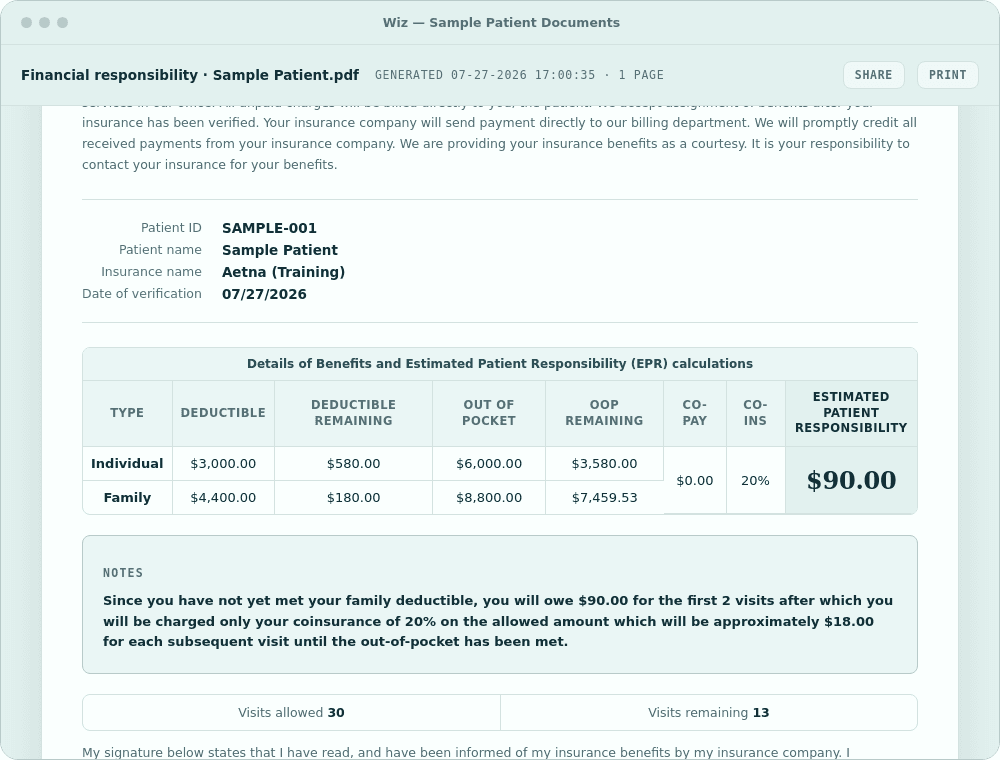
Review a sample patient estimate to see how benefit context, expected services, and patient responsibility can fit into one clinic-ready output.
When patient estimation is done well, the result is fewer surprise bills for patients, fewer write-offs for the clinic, and far more revenue captured at the point of service rather than chased for months afterward.
Why Therapy Clinics Need Therapy-Specific Software
This is where most general estimators fall short. The large patient estimation platforms were built for physician clinics and multi-specialty groups, where a physician visit is usually one visit with a discrete cost. Therapy does not work that way.
Therapy Is an Episode, Not a Visit
A PT, OT, or ST patient typically receives a course of care across many visits. An accurate estimate has to model the full episode, not price one appointment — tracking how the deductible draws down visit by visit, when the patient crosses into coinsurance, and what happens once out-of-pocket maximums are met.
Discipline Carve-Outs Change the Math
Some plans pool PT and OT benefits together. Others split PT, OT, and ST into separate buckets with separate limits. A tool that does not understand discipline-level benefit design will quote the wrong number.
Real-Time Eligibility Responses Are Incomplete for Therapy
The standard eligibility response often does not reliably report therapy copay versus coinsurance, or whether the deductible applies. For several Independent Physician Associations (IPAs), real-time eligibility is not available at all, and coverage details live only inside payer portals that someone has to log into and read manually.
What to Look for When Choosing Patient Estimation Software
Use these criteria to select the right tool:
Accuracy That Protects Collections
The meaningful test is whether pre-visit estimates give the clinic a dependable amount to collect and the patient a clear expectation before care begins. Ask how accuracy is validated, whether performance is reported, and whether hard cases are included.
EMR Integration Without Workflow Replacement
The software should sit on top of your existing EMR as a bolt-on layer, write estimates back into the system your front desk already uses, and require no second login or new workflow. If adopting it means changing how the front desk works, adoption will fail.
Simple Explanations
The software should be able to explain the patient estimate in simple terms. For example, if the patient estimate is lower after a few visits, it should explain that the deductible was met and that is why the patient owes less for the remaining visits.
Separate Quotes for Initial Evaluations vs. Treatment Visits
Because allowables can differ between initial evaluations and treatment visits, the software should calculate patient estimates for each separately.
Secondary Payers
A significant portion of patients have secondary payers, like Medicare Supplemental plans. These secondary payers may cover a portion of the deductible or coinsurance, so the software should account for secondary payers when calculating patient estimates.
Scheduled Eligibility Reverification
Benefits change. A patient who had not met the deductible in January may have met it by March. Look for eligibility reverification that follows the clinic's selected schedule and applicable benefit-reset rules, so estimates stay current and changed coverage or met deductibles are caught before they become refunds or write-offs.
Configurability
Clinics differ in intake workflow, EMR data, estimate format, and eligibility reverification cadence. The software should adapt to your preferences.
Performance Reporting
A strong estimator should report accuracy across the clinic's payer mix and include difficult cases rather than presenting only easy examples.
Results: Higher Patient Collections, Lower Write-Offs
Patient estimation software, when deployed properly by the front desk, can increase patient portion collections and reduce write-offs. The software should provide a monthly summary showing how much was actually collected versus how much could have been collected — showing whether the front desk is explaining estimates properly and collecting patient portions upfront.
How Wiz Health Solves This
Wiz Health was purpose-built for PT, OT, and ST clinics, not adapted from a physician-visit model. Patient estimation runs on the same verified eligibility data used across the platform, so clinics get one accurate number instead of piecing it together from disconnected tools.
Therapy is an episode, not a visit
Wiz Health models the full episode of care — tracking deductible draw-down, coinsurance crossover, and out-of-pocket status visit by visit, not just for a single appointment.
Discipline carve-outs change the math
Built-in discipline-level logic separates PT, OT, and ST benefits automatically, so estimates reflect how each payer actually structures the plan.
Incomplete real-time eligibility data
Where standard eligibility responses fall short, Wiz Health cross-references payer portals and IPA data so therapy-specific copay, coinsurance, and deductible detail isn't left to guesswork.
Fitting into existing EMR workflow
Wiz Health sits on top of your existing EMR and writes estimates back automatically — no new login, no new front-desk workflow.
Secondary payers and changing benefits
Secondary payer logic and scheduled reverification keep every estimate current as coverage changes through the year.
Proven results
Clinics using Wiz Health’s connected eligibility, estimation, and prior authorization workflow see up to 60% fewer denials—protecting earned revenue from avoidable write-offs.